
Many brands operating in China—both foreign and domestic—choose to use two names to represent themselves to Chinese customers: one composed of Chinese characters and another that is alphabet-based, such as an English name. Coca-Cola, for example, does business in China with its American name as well as “可口可乐.” Of course, some brands opt to use just one name in either English or Chinese, but brands with both face the unique visual identity challenge of having separate logos for each or incorporating the two names into one, simple logo design.
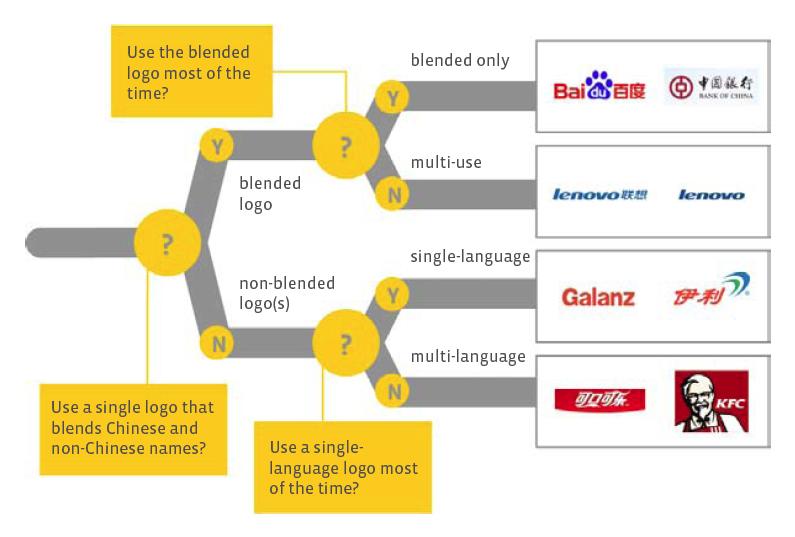
After developing Chinese and alphabet-based names—both significant undertakings in their own right—companies operating in China must choose whether to create a “blended” logo—one that includes both names—and then make additional decisions about how and when to use their logo or logos. These decisions can be depicted as a decision tree (Figure 1).
The first question in the tree is whether or not to create a blended logo. If yes, companies should decide whether they will use this blended logo as their primary logo in China, or whether they will often use non-blended versions of the logo as well—that is, versions that include only one or the other name. Bank of China (中国银行) and Baidu (百度) use their blended logos almost exclusively, while Lenovo (联想) often use their non-Chinese name only, despite having developed a blended logo.
(Figure 1)
For brands that choose not to create a blended logo, the question becomes how heavily to rely on one language over the other. Coca-Cola and KFC (肯德基), for example, do not blend their Chinese-name and English-name logos but use each version frequently in China. Cans of Coca-Cola have English on one side and Chinese on the other. Brands like Galanz (格兰仕) and伊利 (Yili), a dairy company, either do not have logos in both languages or choose to use one language almost exclusively in China.
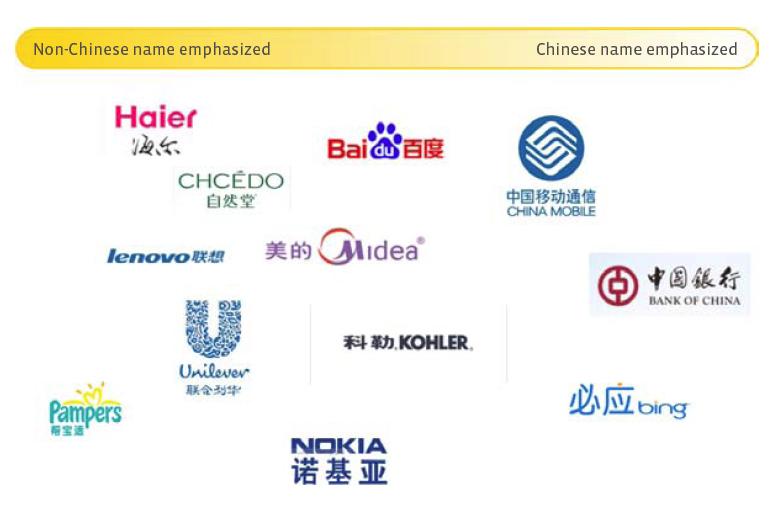
When companies do choose to blend Chinese and non-Chinese names in one logo, designers can allocate emphasis between the two names, as demonstrated in Figure 2. Chinese brands Haier (海尔) and Chcédo (自然堂), as well as Western brands Unilever (联合利华) and Pampers (帮宝适) clearly emphasize their non-Chinese names. On the other hand, China Mobile (中国移动) and Bing (必应) use logos that emphasize Chinese characters over letters.
(Figure 2)
Designers draw attention to one name over the other with a variety of techniques, including the following:
• Position
Names on top or to the left (Nokia; “科勒” in the Kohler logo) appear to be more important.
• Size
One name can be highlighted by making it taller and/or wider (“必应” for Bing; Lenovo).
• Type thickness
Typeface can be altered in several ways to add emphasis to one name or the other. One solution is to make a font thicker (Pampers).
• Use of icon
Names stand out when they are part of icon (Midea’s “M”), or visually resemble an icon in some way (similarity between Unilever’s icon and the letter “U” in its English name).
Other approaches are conceivable as well, including varying color or contrast, using stylized fonts versus more generic-looking options, or even making one name appear to be positioned behind another. Additional considerations for design, which don’t necessarily help influence one name over another, include:
• Avoiding clutter
Including both names (especially if equally weighted) can lead to a complex, large, or unwieldy logo. Emphasizing one name over the other, or finding a unique way to integrate the two names, may help avoid clutter.
• Similarity
Companies can enhance logo recognition by using shared components such as color, typography style, and graphic motifs between Chinese and non-Chinese names. For example, Coca-Cola’s Chinese-name logo is recognizable even without an understanding of Chinese characters. Bing’s logo includes a similar orange dot in both the English and Chinese name.
• Visual connection
Including two names in a logo does create new opportunities for creative connections between the names. See, for example, Momento, a snack bar in a chain of hotels that has connected its non-Chinese name to Chinese characters in a novel way.

The fact that all of the brands listed above are succeeding in China, despite varying approaches to design, demonstrates that there is no clear-cut rule for how to integrate two names into one logo. Instead, the decision must be made on a case-by-case basis. Answers to each of the following questions, preferably supported by market research, should inform the solution.
• Are there benefits of being perceived as foreign/international?
Depending on their category, companies may find that they benefit from being perceived as foreign. If, for example, a wine company believes Chinese consumers associate France with high-quality wine, it may choose to emphasize a French name (whether or not it is truly a French company). Similarly, an international Chinese company might attempt to broadcast its overseas success by highlighting its non-Chinese name domestically. Foreign brands may also choose to keep emphasis on the same name they’re using outside China simply for brand consistency.
• Are there benefits of being perceived as Chinese/localized?
Of course, using a Chinese name in China can increase a brand’s chance of being perceived as relevant—one of the central tenets of brand strategy. Many non-Chinese brands attempt to build relevance in China by emphasizing a Chinese name, and Chinese brands may choose to downplay their non-Chinese name in order to avoid alienating domestic clientele.
• Are there problems with using the non-Chinese name in China?
Perhaps the easiest question to answer is whether a non-Chinese name is difficult for Chinese speakers to pronounce, denotes or implies something negative, or has other usage problems in China. If so, emphasizing the Chinese name is probably the stronger option. When Microsoft introduced Bing to China, they found the English name could easily be interpreted in Chinese as “trouble, mistake, or defect” (毛病, máo bìng) or “virus” (病毒, bìng dú). The solution was to develop the Chinese name “必应” (bì yìng), which can be interpreted as “responds without fail” and is given heavy visual emphasis in the blended logo.
• Which name do customers or prospects seem to prefer?
If a company determines that its customers in China are almost invariably using one name over the other in speech, writing, or both, this could sway the decision in that name’s favor. Furthermore, if a brand’s target audiences consistently speak and read one language more than the other, this should impact which name is emphasized.
• What does the competitive landscape look like?
Examining the decisions made by industry peers may provide valuable insights into naming and logo conventions. Some brands may choose to follow the industry norm, while others may prefer to differentiate by defying industry standards.
• How will each option impact the level of investment required?
For multi-national companies, using two different logos can be a significant expense.
Starbucks, for example, may have factored the cost of printing Chinese-logo cups into their decision to rely more heavily on their English-name logo in China.
Decisions about naming and logo design should be informed by a deep understanding of core values and brand personality, customer profiles and desires, and the competitive landscape. Companies with a well-developed, clearly articulated brand platform based on these insights will have an advantage in answering many of the questions posed within this article. Getting the answers right could prove critical: while a name and logo are only two of many “touchpoints” used to form impressions about your company, the wrong solution could lead to confusion, or worse yet, negative perceptions toward your brand.




To improve your experience, we use cookies to provide social media features, offer you content that targets your particular interests, and analyse the performance of our advertising campaigns. By clicking on “Accept” you consent to all cookies. You also have the option to click “Reject” to limit the use of certain types of cookies. Please be aware that rejecting cookies may affect your website browsing experience and limit the use of some personalised features.