Search for content of interest
  • About
  • ServiceS
    • Branding
    • Innovation
    • Naming
    • Strategy
    • Research
    • Design
  • Work
  • Insights
  • News
  • LOCATIONS
    • Shanghai
    • Paris
    • New York
    • Singapore
    • Kuala Lumpur

CN FR
  • About
  • ServiceS
    • Branding
    • Innovation
    • Naming
    • Strategy
    • Research
    • Design
  • Work
  • Insights
  • News
  • LOCATIONS
    • Shanghai
    • Paris
    • New York
    • Singapore
    • Kuala Lumpur
CONTACT

EN

  • CN
  • FR

Home Insights Our Thinking Detail

EXPERTISE

  • Brand Governance
  • Branding
Contact Us

What Is Brand Governance? 

What Is Brand Governance?  Overview

Brand success depends on sustained quality execution. 

A large majority of brand building investment is made towards brand definition, identity, and activation, including brand positioning, visual identity and media buying. However, a large proportion of this investment is squandered because of a lack of consistency and quality in brand execution. The solution to this problem lies in brand governance. 

What are the components of brand governance? 

‘Brand governance’, sometimes also referred to as ‘brand management’, is often narrowly understood as a ‘brand police’ exercise consisting mostly of the monitoring of basic brand assets usage such as colors or logo. This view however is too narrow. We define brand management as a system of people, processes and tools that work in sync to ensure high-quality, consistent, and impactful brand delivery at scale and over time.  

  • People – refers to the structures, incentives and knowledge that underpin brand execution. This includes the roles of different people, their training and their KPIs  
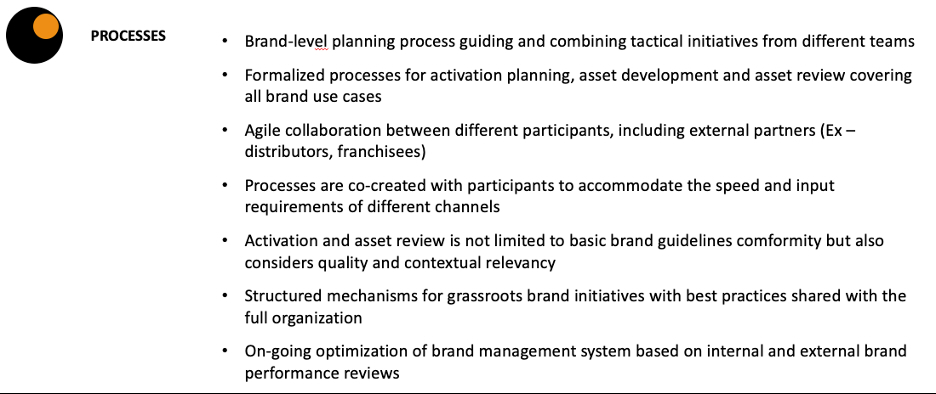
  • Processes – refers to the ways of working that govern the planning, design, and execution of brand activations. From the creative ideation for a brand campaign to the validation of final assets and the measurement of effectiveness, every action should have an associated process with clearly laid out participants and work steps 
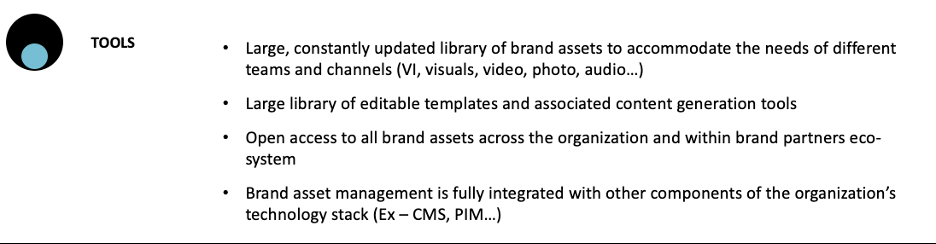
  • Tools – refers to the assets and platforms that support on-going brand management, including creative assets banks, asset management tool, such as DAM (digital asset management) software and content creation tools, such as AIGC solutions. 

Such a definition gives us a full picture of the items that should be included in a brand governance strategy. 

What defines good brand governance? 

Brand governance reflects a company’s culture, business model and brand activation channels. As such no two companies will have the same brand governance model. However, we can define metrics and stages for brand governance maturity 
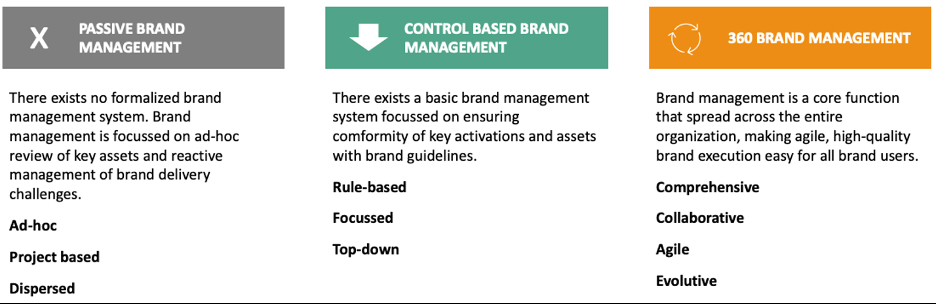
Our own experience indicates that most brands currently stand at the ‘Control based brand management’ stage of brand management maturity, having in place the right setup to ensure basic consistency and guidelines conformity of brand activations. This model can be sufficient for certain companies. Others, especially in highly innovative B2C industries, face higher demands in terms of brand reactivity, coordinated cross channel execution and agile innovation. For these, a further step up to ‘360 brand management’ is necessary. Proceeding to the ‘360 brand management’ stage requires not just additional resources but a shift in focus from control to collaboration and empowerment.  

Why is brand governance key to brand growth? 

As we see, brand governance is what embeds brand strategy within the organization, enabling the on-going coordination of brand activation in accordance with the brand’s vision. Without it, upstream strategy and identity work risks becoming a purely theoretical exercise with no concrete application. Absent brand governance, long term return from tactical brand activation investment, such as content production and media, will also be hampered by lack of consistency in the tone and quality of output. 

Author
Kevin Gentle, Managing Partner

  • SHARE
  • 
  • 
  • 
  • 
BACK

Sign up for our newsletter to get the latest insights, tips, and trends in branding, naming and innovation.

Related Article




How Platform Brands in South-East Asia (SEA) Define Their Brand Positioning: Your Target Matters

This is the 1st part of our 'How Platform Brands in South-East Asia (SEA) Define Their Brand Positioning' article, which will guide you through principles and great cases…

Taking a Journey Mindset: The Facilitation Approach to Brand Innovation and Building

A global consumer goods brand was facing a challenge: Chinese companies were “innovating” much faster than their multinational counterparts, with new brands, new products…

B2B2C Branding: Why the End Consumer Matters

Business to business communication models are changing. In a space that has historically relied on product specs, technical jargon and raw data to drive sales, many B2B b…

Brand Architecture: Should Everything be Branded on its Own?

This article is part of our Brand Architecture series, where we clarify and identify best practices in brand architecture strategies that guide brand growth. Overwhelming…

Slogan Analysis: Car Slogans in China

As environment-friendly cars become an increasingly important market segment, more and more companies are heavily investing in R&D to come up with tomorrow’s winning …

What to Keep in Mind for Brand Naming in China?

As we enter the new decade, everyone is trying to foresee the upcoming trends and become the top player in China’s huge and growing market. In the coming decade, China’s …

Understanding Chinese Brand Names Online

In today’s competitive market, standing out is a challenge. Building a strong brand is essential for creating barriers against competitors. A key element in establishing …

Alcohol Branding for the New Generation: Be Culturally Relevant

Dive into the intricate world of alcohol branding in China, where consumption habits span diverse occasions—from celebratory weddings to family gatherings during the New …

Ready to take your brand to new heights?

Let's start a conversation.
  • NEWSLETTER
  • CAREERS
  • PRIVACY POLICY
  • Labbrand Group
  • Labbrand
  • Madjor
  • SpringPillar

* Will be used in accordance with our Privacy Policy

A Labbrand Group Company © 2005-2025 Labbrand All rights reserved

沪ICP备17001253号-3
  • Follow us:
  • 
  • 
  • 
  • 
  • 
  • 

Contact us to get the latest insights, tips, and trends in branding, naming, and innovation.

* Will be used in accordance with our Privacy Policy

Cookie Notice

To improve your experience, we use cookies to provide social media features, offer you content that targets your particular interests, and analyse the performance of our advertising campaigns. By clicking on “Accept” you consent to all cookies. You also have the option to click “Reject” to limit the use of certain types of cookies. Please be aware that rejecting cookies may affect your website browsing experience and limit the use of some personalised features.

Accept Reject