

As businesses grow, brands tend to multiply.
New products are launched. New business units are formed. Acquisitions are integrated. Sub-brands are created to target different segments. Over time, what began as a clear brand can become a collection of names, identities, and offerings that no longer feel coherent.
For customers, this creates confusion.
For the business, it creates inefficiency.
It becomes unclear what belongs to whom, what each brand stands for, and how they should work together. Marketing efforts fragment. Brand equity is diluted. Internal teams compete for attention and resources rather than building towards a shared direction.
This is not a branding problem in the narrow sense. It is a structural one.
That is where brand architecture becomes essential.
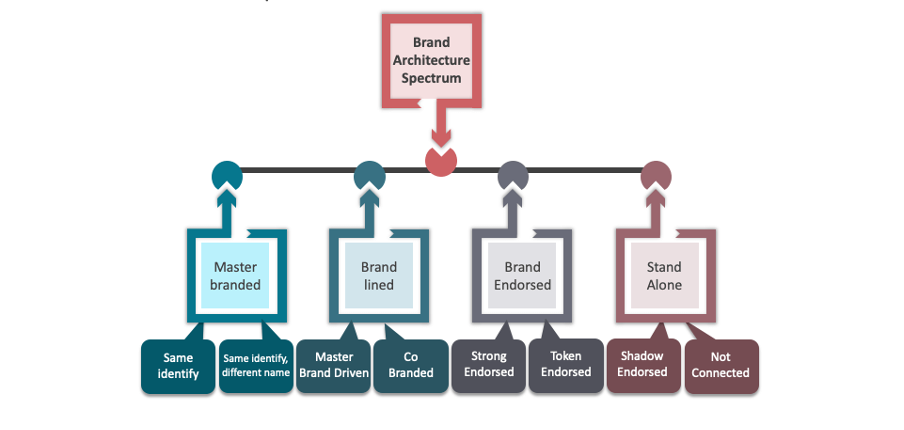
At its core, brand architecture defines how a company organises its brands to support both growth and clarity.
It answers a set of practical questions:
What is the role of the master brand?
Which brands should stand independently, and which should be connected?
How many brands are actually needed?
And how should brand equity flow across the portfolio?
A well-structured brand architecture allows a company to grow without becoming fragmented. A weak one often leads to duplicated efforts, confused positioning, and missed opportunities.
In Malaysia, this challenge is particularly visible among large corporates, conglomerates, and multi-business groups.
Over time, many organisations expand across categories — from upstream to downstream, from B2B to consumer-facing, from local to regional markets. Others grow through acquisitions, bringing in brands that were never designed to sit together.
The result is often a portfolio that reflects history more than strategy.
Some brands overlap. Others are underutilised. Some carry equity that is not fully leveraged, while others struggle to gain recognition despite significant investment.
Without a clear architecture, decisions become reactive:
Brand architecture provides a way to step back and redesign the system intentionally.
Well-known global companies offer useful reference points.
A group like Hilton manages a wide portfolio of hotel brands, each designed for a different segment — from luxury to business to lifestyle. Some brands, such as DoubleTree by Hilton, are closely linked to the master brand, benefiting from its recognition and trust. Others, like Waldorf Astoria, stand more independently to maintain a distinct positioning.
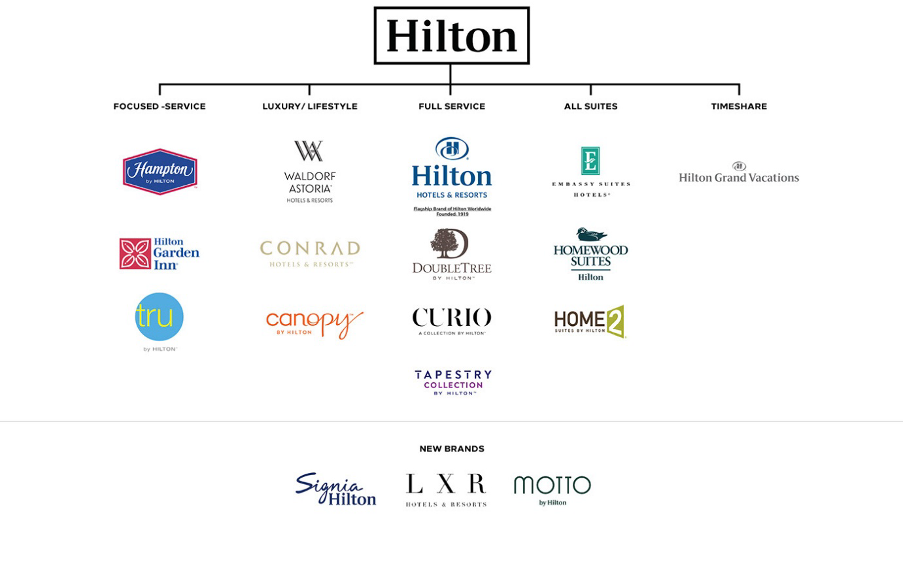
The logic is not arbitrary. It reflects clear strategic choices:
The lesson is not to replicate this model, but to understand the principle:
brand architecture should follow business strategy, not the other way around.
Brand architecture is often mistaken as a naming or visual exercise. In reality, it operates at a deeper level.
It defines how brands:
It also plays a critical role internally.
A clear architecture helps teams understand where they fit, what they are responsible for, and how their efforts contribute to the broader brand system. It reduces duplication, aligns investment, and makes decision-making more efficient.
In this sense, brand architecture is as much an operational tool as it is a branding one.
It is useful to distinguish brand architecture from organisational structure.
An organisational chart defines reporting lines, roles, and responsibilities. It reflects how a company operates internally.
Brand architecture, on the other hand, defines how the business presents itself externally — how its brands are experienced, understood, and chosen.
The two are related, but not identical.
A company may have multiple business units but choose to present them under a unified brand. Alternatively, it may operate as a single organisation but maintain distinct brands for different markets or segments.
Confusing the two often leads to misaligned decisions — where internal structures dictate branding, rather than strategic intent.
One of the central tensions in brand architecture is balance.
On one hand, there is a need for efficiency — fewer brands, clearer focus, stronger equity.
On the other, there is a need for growth — the flexibility to enter new segments, address different audiences, and expand into new spaces.
The goal is not to minimise or maximise the number of brands, but to design a system that does both:
This balance becomes especially important during moments of change:
At these points, reviewing and refining brand architecture is not optional. It is necessary to ensure the brand system can support what the business is trying to become.
A well-designed brand architecture does not draw attention to itself.
Instead, it makes everything else work better.
Customers understand what each brand offers and how they relate.
New products can be introduced with greater clarity.
Marketing becomes more efficient.
And the business can scale without losing coherence.
For organisations in Malaysia looking to grow, transform, or reposition themselves, brand architecture provides a way to move from a collection of brands to a system of brands.
At Labbrand Malaysia, brand architecture is approached as part of a broader strategic process.
It begins with understanding the current portfolio — how brands are perceived, how they perform, and where overlaps or gaps exist. It considers business ambition, market dynamics, and customer expectations. And it translates these into a structure that is both practical and forward-looking.
The aim is not simply to organise brands, but to enable them to work together — supporting clarity today while allowing room for growth tomorrow.
Because in the end, strong brands are not just built individually.
They are designed to function as a system.
If your organisation is managing multiple brands, entering new categories, or navigating growth through expansion or acquisition, a clear brand architecture can bring structure and focus.
At Labbrand Malaysia, we help organisations design brand systems that support both clarity and long-term growth.




To improve your experience, we use cookies to provide social media features, offer you content that targets your particular interests, and analyse the performance of our advertising campaigns. By clicking on “Accept” you consent to all cookies. You also have the option to click “Reject” to limit the use of certain types of cookies. Please be aware that rejecting cookies may affect your website browsing experience and limit the use of some personalised features.