Search for content of interest

  • About
  • ServiceS
    • Branding
    • Innovation
    • Naming
    • Strategy
    • Research
    • Design
  • Work
  • Insights
  • News
  • LOCATIONS
    • Shanghai
    • Paris
    • New York
    • Singapore
    • Malaysia

CN FR
  • About
  • ServiceS
    • Branding
    • Innovation
    • Naming
    • Strategy
    • Research
    • Design
  • Work
  • Insights
  • News
  • LOCATIONS
    • Shanghai
    • Paris
    • New York
    • Singapore
    • Malaysia
CONTACT

EN

  • CN
  • FR

Home Insights Our Thinking Detail
Contact Us

Multi-Brand Strategy in the Modern Market

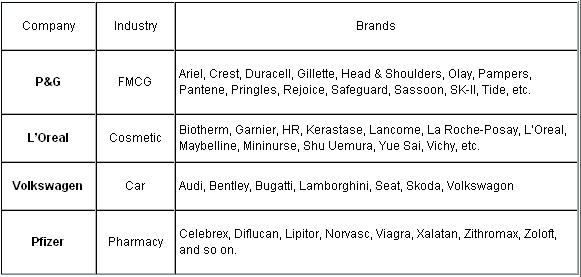
We all know that our lifestyle is filled with a large number of branded products, but you may not realize that many of the most commonly used product brands—Crest toothpaste, Pantene shampoo, Gillette shaving cream, Pringles potato chips and Duracell batteries—in fact belong to one company, in this case Proctor & Gamble (P&G). It has become very common for a company to have a portfolio of multiple brands, but what is the advantage of adopting a multi-brand strategy in today’s market? 

Looking at several multi-brand companies, we can see that most exist in the B2C industries. For instance, this phenomenon can be observed in FMCG, cosmetics, automobile, as well as pharmaceutical fields. The following graph shows examples of companies in these industries, as well as their brands: 

Unlocking consumer relevance and market influence, B2C industries strategically embrace multi-brand strategies to navigate the intricate landscape of diverse consumer preferences. In contrast to B2B sectors, where market segmentation is less pronounced, B2C companies recognize the need to tailor their approach to consumers with varied purchasing factors. Attempting to address this complexity with a single brand can challenge maintaining a strong brand identity. P&G’s multi-brand strategy exemplifies this approach, with distinct shampoo brands such as Head & Shoulders for dandruff control, Pantene for healthy hair, and Sassoon for a professional salon experience. This strategic diversification enables companies to occupy multiple market positions, maximizing relevance and resonance with consumers in an ever-evolving market.

From the brand management perspective, having multiple brands is a portfolio strategy which can maintain the continuity of profit-generating activities. The BCG Matrix model (pictured below) is based on the two indexes “current market share” and “market growth potential”. The brand portfolio of a company can be divided into four quadrants with each part representing a function. Using the example of L’Oreal, we will use this structure to illustrate the multi-brands practices. 
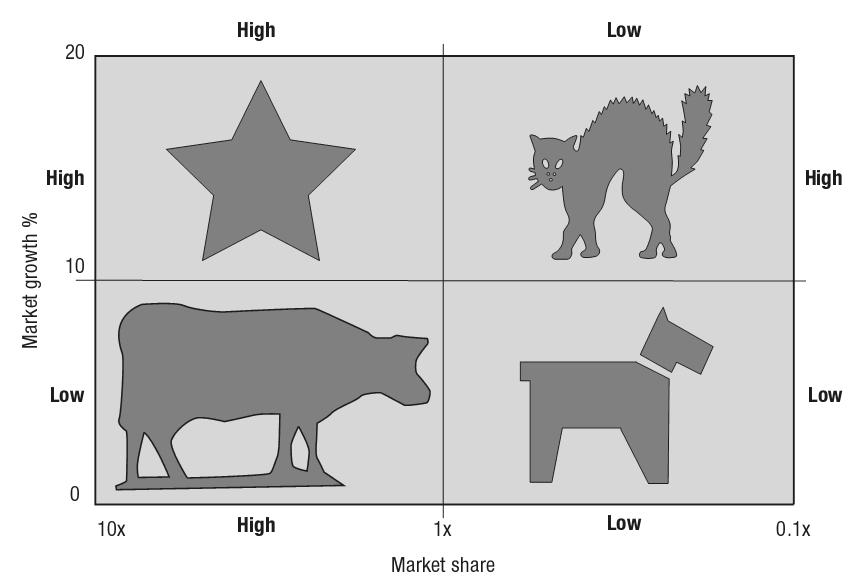
  1. Cash cow: a “cash cow” brand possesses a large market share, but its market growth potential is limited. In this case, the reputation of the brand has been established and the brand is profitable. The optimized choice is to maximize the current revenue from the brand. 
  2. Star: a “star” brand possesses a large market share, and at the same time, its market growth potential is promising. Like the name, this kind of brand is the star of a company because it has high positioning and generates high revenue. A “star” brand is a good indicator of a company’s activities and profile. For L’Oreal, Lancôme is the star because it occupies a leading position in the premium cosmetics market. 
  3. Dogs: “dogs” are brands lacking both market share and growth potential. This kind of brand is usually in the later stages of its brand-life, and should be removed from the market as soon as possible. 
  4. Wildcats: a “wildcat” brand has a small market share but good growth potential; it has the potential to become a “star” or a “dog”. To help the brand become a star, the company should increase advertising and promotional activities. For L’Oreal, Shu Uemura can be viewed as a “wildcat” in the China market. 
  5. The BCG Matrix model expresses the dynamic process of a brand’s life. Every brand has it own life: growth, maturity, aging and death. By having multiple brands, the company can offset the negative effects of its unprofitable brands. 

Strategic Insights into Multi-Brand Strategy: Balancing Risks and Rewards

Delving into the realm of brand portfolio management reveals that opting for a vast brand portfolio is a strategic move best suited for larger corporations, steering clear of higher risks that may overwhelm smaller counterparts. This nuanced strategy demands careful consideration, especially when it comes to positioning the company’s brands within the same market. The absence of clear brand positioning can inadvertently spark unhealthy competition among the brand siblings, potentially harming the overall corporate entity. An additional challenge surfaces in the form of cost control, where the management of an expansive brand portfolio inevitably translates to higher operational costs. To navigate these intricacies, savvy companies often lean towards the strategy of brand extension, seamlessly extending a brand from one market to another. This prudent choice ensures strategic growth while mitigating the risks and cost implications associated with the management of a diverse multi-brand portfolio. Explore the strategic landscape of brand management as we delve into the considerations influencing the choice between multi-brand portfolios and brand extension.


Download the report

  • SHARE
  • 
  • 
  • 
  • 
BACK

Related Article




How to Get Your Team Aligned After a Comprehensive Brand Consultation

Engaging a professional brand consultancy can be a transformative experience for your business.. An integrated brand approach defines how consumers perceive and remember …

Chinese Báijiǔ Branding Strategy

Decoding the Essence: Báijiǔ Branding Strategy Unveiled China's rich tradition of hospitality finds expression in the ritual of toasting with báijiǔ, a traditional distil…

Changyu’s brand strategy: unique grapes and Chinese culture

SIAL Group, a leading Food & Beverage industry trade organizer globally, has recognized Changyu, a prominent Chinese winemaker, as one of the top 30 wine brands world…

Brand Positioning in the Airport Industry: The World’s Best Airport Changi

Explore the unique brand positioning in the airport industry with the introduction of Jewel Changi. Since its April opening, this joint venture between Changi Airport and…

White Rabbit Branding—From Nostalgic Sweet Goodness to Iconic Retro

White Rabbit creamy candy has become a hot spot on social media this year. From this brand's lipsticks that were sold out within seconds, to clothes, perfume, skincare, m…

Being Authentic about Brand Diversity

Diversity – a word that enraptures the world with equal parts trepidation and hope. Brand diversity has permeated all layers of social dialogue and corporate ve…

Winter is Coming for Marks & Spencer? Common Brand Pitfalls Falls into in China

Navigate potential brand pitfalls in the Chinese market by leveraging imported products' quality, foreign brand legacies, and European-style presentation. Brands like Mar…

Elements in China Cultural Design: An Opportunity for Innovation through Mix and Match

Chinese elements are easily recognizable, highly differentiated, and connected to cultural characteristics. They are signified in arts, ideology, lifestyle, and more. Som…

Ready to take your brand to new heights?

Let's start a conversation.
  • NEWSLETTER
  • CAREERS
  • PRIVACY POLICY
  • Labbrand Group
  • Labbrand
  • Madjor
  • SpringPillar

* Will be used in accordance with our Privacy Policy

A Labbrand Group Company © 2005-2025 Labbrand All rights reserved

沪ICP备17001253号-3
  • Follow us:
  • 
  • 
  • 
  • 
  • 
  • 

Contact us to get the latest insights, tips, and trends in branding, naming, and innovation.

* Will be used in accordance with our Privacy Policy

Cookie Notice

To improve your experience, we use cookies to provide social media features, offer you content that targets your particular interests, and analyse the performance of our advertising campaigns. By clicking on “Accept” you consent to all cookies. You also have the option to click “Reject” to limit the use of certain types of cookies. Please be aware that rejecting cookies may affect your website browsing experience and limit the use of some personalised features.

Accept Reject