

Brand Building is not a simple task.
Sometimes brands promote themselves visually through a strong identity and flashy advertising. Others take a step back, conduct market research, and clearly map out their brand positioning. Some brands enter the market with a strong presence and disappear overnight; others last for a lifetime. Although different approaches are used, almost every brand has the same goal in mind: to increase brand value.There has been much academic and professional commentary on what branding is, whether it is worthwhile, and how it can be done properly. There is talk of personal branding, nation branding, re-branding, branding during the economic downturn, and more, but often there still isn’t a clear understanding of what branding is even among practitioners.
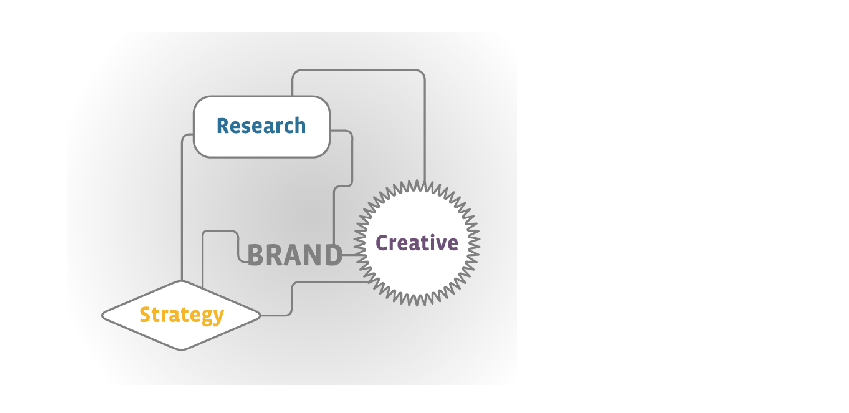
At Labbrand, we recommend an approach that integrates market research, strategy, and creative aspects of the brand in order to build brand equity. In this article, we’ll tell you why these three elements should be used together, and why it works.
Communication can refer to any method used to broadcast the brand in the public space, to both the target market and consumers in general. For many brands, the ultimate aim of these activities is to sell more of their product or service.
In his book A Branded World, Michael Levine differentiates between Marketing, Advertising, and PR, the three most common communication activities:
-Advertising: one way for the public to find out about the brand. The design and content of the advertising will impact how the brand is seen by consumers.
-Marketing: knowing what to sell and how to sell it.
-Public Relations: generates publicity for the brand, solidifies public opinion, and defines the brand using indirect methods.
Usually when people think about how to build or promote a brand, they think primarily of communication. But communication alone is not enough. As Ind and Watt (2005), writers and consultants in the field of branding and creativity, stated, “the problem in many organizations is that the brand is under-utilized. It may steer marketing communications, but it is not fully embedded into creative thinking and innovation” (p. 334). Similarly, when Volvo developed the Cross Country, Sara Ohrvall, the Concept Manager, said “The project started with the strategy: the role of the car for the overall brand. So innovation is always done within a specific Volvo context. You start with the brand and then you say what is the role of this car in the brand and what is the position of the car in the market against other cars” (Ind & Watt, 2006, p. 334). As you can see, a brand is not only a name or logo to be publicized in order to increase sales; the brand forms the foundation for business activities.
Furthermore, the brand is more long lasting than any single advertising campaign or product promotion. It is a promise to consumers; it is a company’s reason to be. As Murphy (2007), a branding consultant puts it, “Although marketing and communications budgets might rise and fall, commitment to the brand must again remain consistent” (p. 31). An integrated brand that is more than just communications driven will provide long lasting benefits in the area of market leadership, company focus, and profitability (LePla & Parker, 1999). By looking at the multifaceted aspects of a brand, specifically the dimensions of market research, brand strategy, and creativity, it effectively ensures that branding goes beyond communication alone.

Since a brand impacts all aspects of a company’s relationship with its consumers, it is not enough for only the marketing department or the CEO to take ownership of it—the entire organization needs to understand what the brand stands for and what their role is in contributing to its vision. As a company-wide endeavor, the brand must incorporate strategic, creative, and market understanding to allow all departments to relate to it in a relevant way.
In today’s organizations, brand management itself is becoming an organization-wide and cross-functional team based activity, instead of being centralized in one department or one individual, again making it essential for a multidisciplinary perspective on branding to be adopted. The brand must be thought of in the mindset of different stakeholders. Strategic decision makers, market analysts, and creative functions will all look at the brand from a slightly different angle. Using research, strategy, and creativity is a prerequisite to enable adoption throughout the organization. It gives clear directions and tools to plan and conduct efficient engagement activities in the different teams within the company.

It is clear for most marketing or brand managers that strategy should guide all advertising, promotion, and public relations activities. Also, there are still some businesspeople who equate branding with coming up with brand names and logos (in other words, the creative aspects of the brand). But, it is not so widely accepted that market research should play a role in brand building. As Ind and Watt (2006) said, “understanding stakeholders’ needs and experiences with a brand should be based on a combination of well considered research and the collected experiences of managers, team members, employees, supply chain partners, and customers” (p. 355). Similarly, Murphy (2007) explained “Regular research helps organizations chart the process of development among both internal and external audiences…The gathered data will also help direct the brand’s continued evolution”.
It is clear that brand-led businesses should be built by blending branding with market research while incorporating creativity.
Strategic Brand Building: Fostering Seamless Consistency
In the dynamic realm of business, brands must actively pursue a seamless connection and unwavering consistency across various touchpoints. Whether reflected in the company’s culture, product design, advertising efforts, packaging, website interface, instructional manuals, or promotional materials, consistency is the bedrock of a strong brand identity. The crucial question arises: How can this synchronicity be achieved without embracing a holistic approach? Let’s unravel the art of strategic brand building and explore the transformative impact of adopting a comprehensive strategy that ensures your brand speaks cohesively across all facets of its presence.
If brand building is more than communication, if the brand is managed by the whole organization in a variety of functional groups, and if research is crucial for a brand’s success, then an integrated, multi-disciplinary approach to brand building is essential, one that includes market research, brand strategy, and creativity all under one branded roof.
Sources:
Chernatony, Leslie de. (1997). Integrated brand building using brand taxonomies. The
Journal of Product and Brand Management, 6(1), 56-63.
Ind, N., & Watt, C. (2006). Brands and breakthroughs: How brands help focus creative decision making. Brand Management, 13(4/5), 330-338.
LePla, J., & Parker, L.M. (1999). Integrated branding: Becoming brand-driven through companywide action. Westport, CT: Quorum Books.
Levine, M. (2003). A branded world. Hoboken, NJ: John Wiley & Sons, Inc.
Murphy, R. (2007). Built Brand Tough. Mark Health Serv, 3(7), 44.




To improve your experience, we use cookies to provide social media features, offer you content that targets your particular interests, and analyse the performance of our advertising campaigns. By clicking on “Accept” you consent to all cookies. You also have the option to click “Reject” to limit the use of certain types of cookies. Please be aware that rejecting cookies may affect your website browsing experience and limit the use of some personalised features.