
In April 2013, Chinese e-commerce giant 360Buy announced that its domain name would officially change to JD.com with a new visual identity and a new brand mascot “Joy”, the metal dog.
Old Chinese Name: Jing Dong Mall
Old English Name: 360Buy Group
Old Domain: 360buy.com

New Chinese Name: Jing Dong
New English Name: JD or Jing Dong
New Domain: JD.com
As the second largest e-commerce platform in China, Jing Dong’s domain and logo change are necessary. It was difficult for consumers to associate “360buy” to Jing Dong and there was a major discrepancy between its well-known Chinese name and the access domain. Overall, consumers had trouble remembering the exact URL and thus relied heavily on Baidu searches to find Jing Dong. On the other hand, Jing Dong’s rebranding effort is a response to the increasing pressure from TMall, who begun to rebrand since early 2012 with a new name, logo and mascot.
“Jing Dong is always client-oriented,” said LIU Qiangdong, the founder of Jing Dong. “The simpler domain name and the more human logo represent our joyful shopping experiences for consumers and new values for suppliers.” In the new advertisement for the launch of JD.COM, the abbreviation of Jing Dong is explained by four definitions: Jue Ding(decision), Jie Du(Reading and understanding), Jian Dan(Simplification), Ji Dong(passion). These definitions reveal the intention to create a harmonious, pleasant and safe environment for consumers and suppliers.
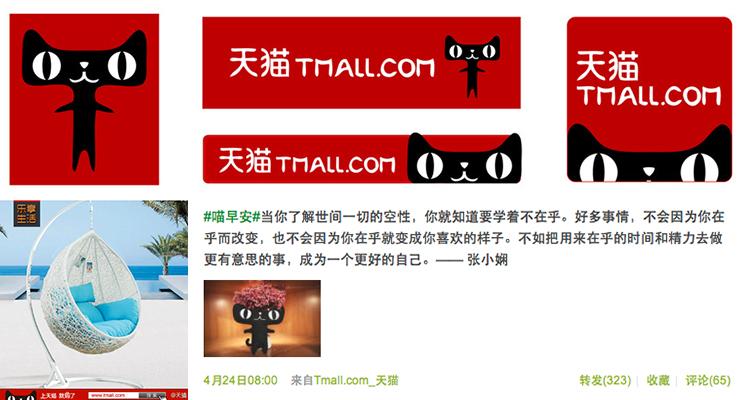
Almost immediately after the announcement, Chinese reporters and consumers started to discuss the intention of Jing Dong’s brand visual identity – Joy, the metal dog. Some speculate that it is directly going against TMall’s cat . After a closer look, how Jing Dong and TMall leverage their brand mascot is quite different.
For TMall, the cat is the central focus of their communication and promotion. Each banner, icon, display picture, and social media content is closely linked with the cat. To create buzz, TMall also created its own unique writing style with the signature cat sound “meow” (喵).
Although it might be too early to tell, as Joy has been only revealed for one month, Jing Dong seems to be using Joy to create initial media attention instead of using the mascot in its day-to-day communication. Except for the initial launch videos, Joy is hardly seen anywhere else.
Brand mascot can be a powerful tool. Its purpose goes beyond being cute and friendly. It can embody the brand attributes, solidify brands’ visual identity and extend the brand to both online and offline touch points. In this case, Joy can be a potential differentiating factor and help to create long term brand-consumer relationship to enhance brand loyalty, which is a challenging factor for Chinese e-commerce platforms.
As an ambitious retailer, Jing Dong is planning to transform into a powerhouse that goes beyond e-commerce. At the end of 2012, Jing Dong quietly purchased a 3rd party online payment corporation called Chinabank Payment (网银在线 or wang yin zai xian. Note: wangyin means “internet bank”). In April 2013, data from the Chinese domain registry shows that Jing Dong acquired the domain wangyin.com as well. This announcement is also seen as directly competing with Alibaba’s dominating Alipay system. Besides establishing its own payment platform, Jing Dong also plans to turn their reputable logistic team into a delivery service/kuaidi, which is a competitive advantage for Jing Dong over Alibaba’s Taobao or TMall. With these expansion plans, changing the brand from a number+buy naming module to a simplified version is beneficial. Whether it’s Dog vs. Cat or Jing Dong vs. Alibaba, the competition ahead for Chinese online retailers will be fierce yet fruitful.




To improve your experience, we use cookies to provide social media features, offer you content that targets your particular interests, and analyse the performance of our advertising campaigns. By clicking on “Accept” you consent to all cookies. You also have the option to click “Reject” to limit the use of certain types of cookies. Please be aware that rejecting cookies may affect your website browsing experience and limit the use of some personalised features.