

In recent years, a discernible shift has emerged in the consciousness of Chinese companies, indicating a heightened awareness and understanding of the paramount significance of brand building. Conscious of the positive association between foreign brands and product quality that resonates in the minds of Chinese consumers, a growing number of domestic enterprises are strategically crafting brand names that exude an international allure, aiming to captivate their target audience. This naming strategy is notably pervasive in sectors such as fashion, real estate, and household goods. Below is a curated list showcasing some of the most popular brands in these industries, offering insights into the evolving landscape of name analysis and its impact on effective brand development.
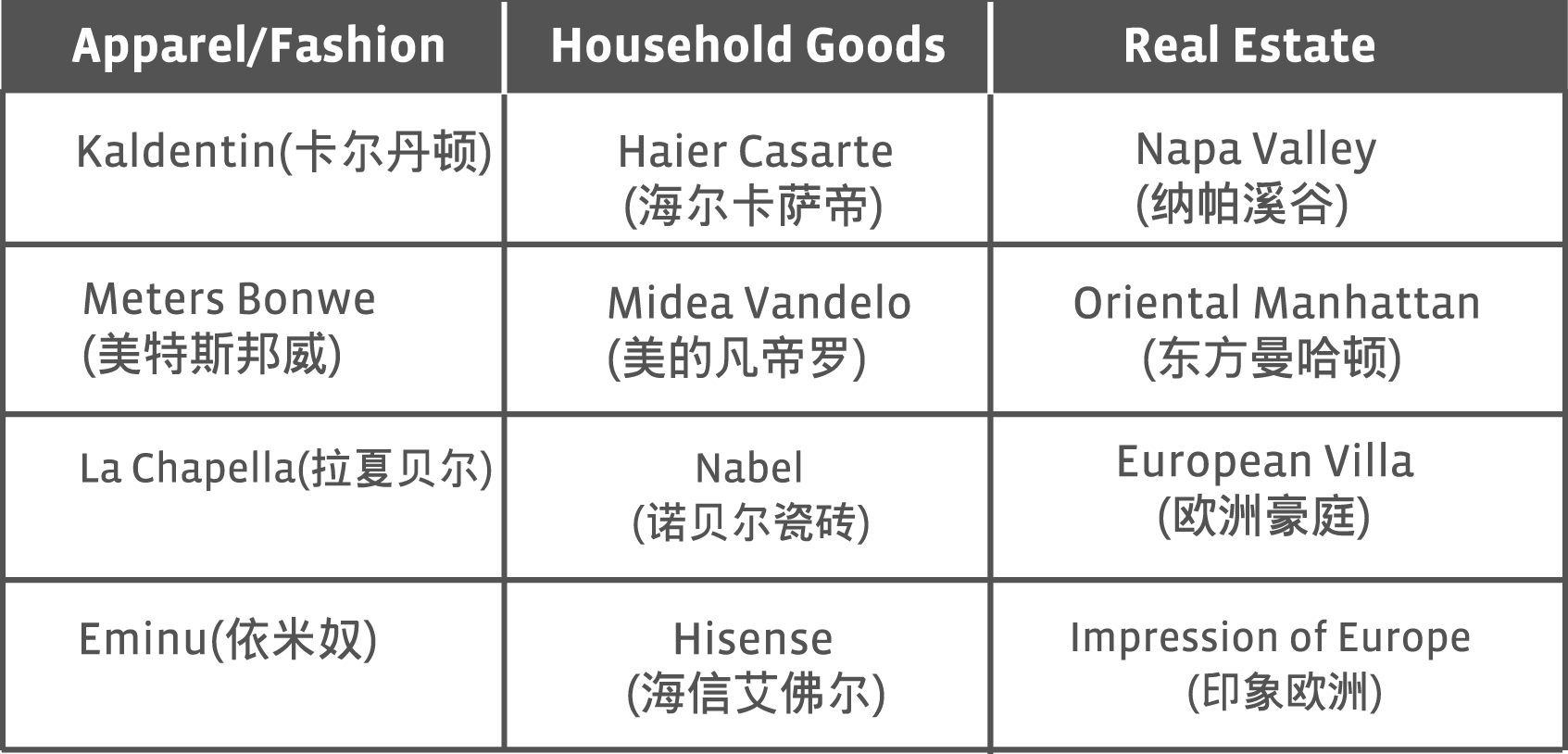
Although the above table only illustrates four brands for each of the industries, the number of companies using this strategy is actually much larger. For example, according to recent news reports, almost 80% of the Chinese apparel/fashion brand names are foreign sounding. In the following section we will analyze three brands in greater detail, one from each industry.

Meters Bonwe (美特斯邦威) is a casual apparel brand established in 1995 in Wenzhou, Zhejiang. The brand targets a younger crowd, mainly college students, who prefer cheap clothes, yet still want to look fashionable and distinguished. The brand uses celebrities that are popular among the target group and who can convey the brand message of being cool and different, such as Jay Chou (周杰伦).
According to the founder of the brand, Chengjian Zhou, each character in the brand name should be explained as follows:
“美” [měi] means beautiful or fashionable in Chinese. “特” [tè] stands for different or distinctive. “斯” [sī] means to be present and aware. “邦” [bāng] refers to the idea of nation or country. “威” [wēi] could be explained as power or imposing manner. Although the founder seems to have his idea of what the brand stands for, his explanation of the characters used in the name is not clear. For example, the third character “斯” [sī], which can be commonly found in ancient Chinese manuscripts, has a variety of different connotations (including “this”, “hack”, “ignobleness”, etc), all but the one that the brand founder himself mentioned.
Furthermore, although all these single characters have their own specific connotations, when combined the brand name “美特斯邦威” [měi tè sī bāng wēi] does not have a meaning. However, it does sound like a foreign word, which is probably the intended goal of the company as it tries to evoke an exotic association in consumers.

Vandelo (凡帝罗) is a newly launched fridge brand that belongs to the Home Appliance Business Unit of MideaGroup, which was established in 1968 and originated in Foshan, Guangdong. The brand claims that its products are designed in France and that they are on par with European standards. It targets the high-end consumers in Chinese market.
“凡” [fán] means ordinary or common in Chinese. “帝” [dì] means emperor, king or God. “罗” [Luó] is a common surname in China, but also means to collect and to display.
Once again it is evident that the original name was conceived in English and then eventually translated into Chinese. However when placed together the characters “凡” [fán] and “帝” [dì] seem to suggest that today the most ordinary people “凡人” [fán rén] can access products of impeccable quality that previously belonged only to the elites.

Impression of Europe (印象欧洲) is the name of an exclusive apartment complex in Shanghai.
“印” [yìn] in Chinese means print or stamp while “像” [xiàng] means likeness or image. Together the word “印象” stands for impression. The character “欧” [ōu] is solely used to refer to Europe or as a surname in Chinese. “洲” [zhōu] mean continent.
There are countless examples of foreign-sounding real estate complexes in China. In recent years, this branding strategy has been adopted by a number of developers. Romantic and exotic sounding names such as “Europe”, “Venice”, or “Provence” have literally flooded the real estate market in cities like Shanghai and Beijing, where consumers are constantly searching for the luxury of the foreign experience.
The practice of Chinese brands adopting foreign names stems from two key perspectives. On the company side, the increasing demand for foreign products is a driving force. Some companies view a foreign name as a competitive advantage in both domestic and international markets. From the consumer standpoint, a “foreign” brand addresses psychological needs and status motivations. Consumers often associate product quality with the brand’s origin, emphasizing the significance of the “country of origin” factor. However, given the numerous scandals involving tainted products and false claims in China in recent years, it is evident that relying solely on a foreign-sounding name is insufficient to convince discerning Chinese customers. Additionally, if an excessive number of indigenous brands adopt foreign-sounding names, the meaningful differentiation associated with such names may diminish, prompting the need for alternative strategies to be considered, including comprehensive name analysis.




To improve your experience, we use cookies to provide social media features, offer you content that targets your particular interests, and analyse the performance of our advertising campaigns. By clicking on “Accept” you consent to all cookies. You also have the option to click “Reject” to limit the use of certain types of cookies. Please be aware that rejecting cookies may affect your website browsing experience and limit the use of some personalised features.