

Most companies do not struggle with innovation because they lack ideas.
In fact, the opposite is usually true. There are often too many ideas, too many ambitions, too many disconnected initiatives happening at once. What is missing is not creativity, but clarity: clarity on what innovation actually means for the business, how it should be organised, and which priorities matter most.
This is why innovation benchmarking matters. Not as a comparison exercise for its own sake, but as a decision-making tool.
When done poorly, innovation benchmarking becomes a familiar corporate ritual: a few competitor examples, a handful of best-practice references, and a conclusion that the organisation should “innovate more.” When done properly, it becomes something much more useful. It helps a company understand where it stands today, why progress feels uneven, and what needs to change first.
At Labbrand, we see innovation benchmarking as part of a larger process: diagnosing the current system, building an innovation scorecard grounded in evidence, identifying the most important gaps, and translating those findings into a practical innovation roadmap.
One of the biggest mistakes organisations make is rushing into external benchmarking before they have properly understood their own internal reality.
It is always tempting to look outward first. Competitors seem easier to analyse. Best-in-class innovation stories are inspiring. External examples create momentum in the boardroom. But without internal diagnosis, benchmarking often leads to imitation rather than strategy.
That is why our work usually starts with an internal audit.
This means speaking to the people who shape and experience innovation from different angles: leadership, R&D, operations, digital, and other stakeholders involved in moving ideas through the organisation. These conversations are often paired with internal surveys to explore mindset, barriers, incentives, and perceptions of innovation culture. We also review governance structures, processes, current initiatives, and whatever formal systems already exist.
What emerges is rarely a lack of intent. More often, it is a lack of alignment.
In internal audits, we often see patterns like:
These are not minor frustrations. They are structural signals. And they matter because external benchmarking alone cannot explain them.
A company may admire what peers are doing, but unless it understands its own internal blockers, even the most inspiring benchmark will remain superficial. In practice, internal diagnosis is often more valuable than external comparison, because it reveals why innovation feels difficult inside the organisation in the first place.
Once the internal picture becomes clearer, the next step is to build an innovation scorecard.
This is where benchmarking becomes more disciplined. Rather than relying on opinion or ambition, the scorecard creates a structured view of innovation maturity based on actual evidence.
At Labbrand, the innovation scorecard is not a generic template. It is built around the realities of the organisation and the role innovation is expected to play within it. In our work, this often includes dimensions such as:
1. Corporate Influence
How innovation is supported, directed, and legitimised at the corporate level.
This includes leadership alignment, governance, decision rights, strategic sponsorship, and how well innovation is connected to broader business priorities.
2. Role of R&D and Innovation Metrics
How R&D innovation is positioned, supported, and measured.
In many businesses, R&D has strong technical depth but is still treated mainly as a support function. This part of the scorecard looks at whether R&D is playing a narrow technical role or a broader role in value creation, and whether there are meaningful innovation metrics in place.
3. Internal Culture and Structure
Whether the organisation’s operating model truly supports innovation.
This includes talent, incentives, collaboration, team design, internal mindsets, and the often difficult relationship between business-as-usual work and exploratory innovation.
Within each dimension, we define themes, evidence points, and best-practice references. That is what makes the scorecard useful: it is not built from theory alone, but from patterns observed through interviews, surveys, documents, structures, and behaviours.
A good innovation scorecard should not measure what the organisation says it values.
It should measure what the organisation actually enables.
For example, if leadership describes innovation as a strategic priority but teams cannot explain who owns it or how ideas move forward, that gap becomes visible. If employees are encouraged to think creatively but do not have time, funding, or pathways to experiment, that also becomes visible. If there are no clear innovation metrics beyond operational KPIs, that shapes the maturity picture too.
This creates a more objective view of innovation capability — not perfect objectivity, but a grounded one.
Once the innovation scorecard is in place, external benchmarking becomes far more meaningful.
We do look at competitors and sector peers. They provide important context: how others are structuring innovation, where the industry is moving, and what pressures are shaping strategic choices. But innovation benchmarking should not stop there.
Some of the most useful lessons come from organisations that are not direct competitors at all, but are strong in particular parts of the innovation system.
For example, one company may have a better governance model for innovation decision-making. Another may have built a clearer innovation team structure. Another may be more advanced in how it manages external partnerships with startups, universities, or ecosystem players. Another may have stronger ways of separating long-term exploration from short-term operational delivery.
Best-practice benchmarking often looks at:
This matters because competitors show the context, but best-in-class models show what is possible.
The goal is not to copy another organisation’s model wholesale. It is to understand which parts of their system are enabling better innovation outcomes, and which of those lessons are relevant.
By this stage, the most important gaps usually become clear because they appear from multiple angles at once.
They show up in interviews. They show up in behaviours. They show up in structural limitations. And they become even more obvious when viewed against best practice.
In many organisations, the same challenges tend to repeat:
These issues may sound familiar because they are. But the important thing is not simply listing them. It is understanding how they interact.
For example, a lack of innovation metrics is not just a measurement problem. It affects accountability, resource allocation, and leadership visibility. Unclear decision-making is not only a governance issue; it shapes confidence, speed, and momentum. BAU versus innovation conflict is not merely a workload problem; it determines whether the organisation is capable of long-term thinking at all.
This is why evidence-based gap identification matters. It moves the discussion away from vague frustration and toward a clearer diagnosis of the system.
Most organisations do not need more findings. They need sharper decisions.
Once the gaps are visible, the next question is: what should happen first?
Trying to address everything at once is usually a mistake. It overwhelms teams, dilutes focus, and often leads to a roadmap that looks comprehensive but never really lands. That is why prioritisation is essential.
Our approach uses an impact × feasibility matrix to assess which gaps deserve early focus.
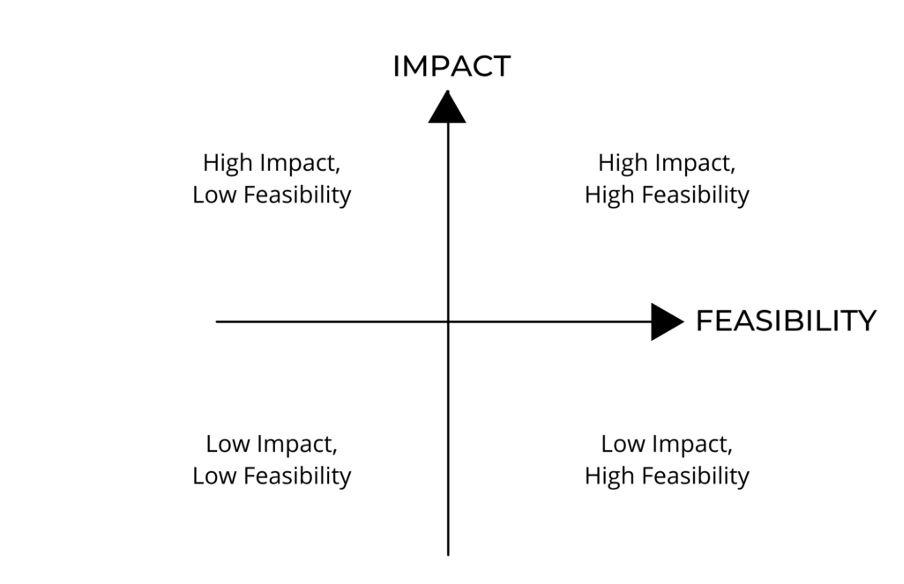
Some issues are high impact but difficult to shift quickly because they involve structural or leadership changes. Others are more feasible and can unlock momentum earlier. The purpose of the framework is to help organisations focus on what will move the system most effectively, rather than what sounds most ambitious.
Why this matters:
Prioritisation is where innovation strategy becomes real. It forces choices. It creates focus. And it gives the organisation a more honest sense of what progress should look like.

A strong innovation roadmap is not just a timeline. It is a sequence of organisational change.
In the short term, the priority is often clarity and alignment. This may involve sharpening innovation definitions, clarifying ownership, improving governance, or creating quick wins that reduce confusion and build confidence.
In the mid term, the work usually becomes more structural. This is where capability building happens: stronger innovation metrics, clearer R&D roles, better cross-functional integration, more formal innovation pathways, and better separation between exploratory work and BAU.
In the long term, the roadmap can become more transformative. At this stage, the organisation is better positioned to pursue new value creation, bigger partnership plays, and more future-facing innovation opportunities.
A practical innovation roadmap often works across three horizons:
This time-horizon approach matters because innovation does not play a single role. In many organisations, it needs to operate across three modes at once:
A useful innovation roadmap makes room for all three, while being realistic about what the organisation can build over time.
The most important lesson from innovation benchmarking work is this: innovation is not something a single department can solve on its own.
It is a system shaped by leadership, governance, structure, incentives, culture, and decision-making. That is why innovation benchmarking should not end as a comparison exercise or a maturity score. Its real value lies in creating clarity, alignment, and forward motion.
At Labbrand, we do not treat innovation benchmarking, innovation scorecard development, prioritisation, and roadmap building as separate pieces of work. They are connected steps in a single logic.
Insight should lead to prioritisation.
Prioritisation should lead to action.
And action should be grounded in how the organisation actually works.
A strong corporate innovation strategy is not built from ambition alone. It is built from evidence, choices, and the discipline to focus.
That is what makes innovation benchmarking useful. And that is what turns it from a passive comparison exercise into something much more valuable: a way to move the organisation forward.
If your organisation is rethinking how innovation is defined, measured, or prioritised, Labbrand can help. We work with leadership teams to turn innovation from a broad ambition into a clearer system — grounded in evidence, aligned to business priorities, and structured for action.
Explore Labbrand Malaysia’s innovation consulting approach
or get in touch to discuss innovation benchmarking, scorecard development, and roadmap design.




To improve your experience, we use cookies to provide social media features, offer you content that targets your particular interests, and analyse the performance of our advertising campaigns. By clicking on “Accept” you consent to all cookies. You also have the option to click “Reject” to limit the use of certain types of cookies. Please be aware that rejecting cookies may affect your website browsing experience and limit the use of some personalised features.