

Brand strategy is often reduced to language.
A positioning statement is written, a purpose refined, a set of values agreed — and the brand is considered “defined”. Yet in practice, many organisations, especially large and established ones, find these outputs don’t travel very far. They may align a workshop, but not a business. They may sharpen a presentation, but not a market position.
The issue is not the importance of strategy, but how it is approached.
Too often, it becomes a verbal exercise, disconnected from the realities that shape a brand: the category it operates in, the culture around it, the audience it serves, and the internal ambition it needs to express.
At Labbrand Malaysia, brand strategy starts earlier and goes deeper. It begins with understanding before articulation — and builds structure before expression. The goal is not just to define what a brand wants to be, but to shape something that can guide decisions, experience, and growth over time.
A useful brand strategy needs to do three things at once:
It must stay relevant to customers.
It must clearly differentiate from competitors.
It must connect with where the category — and culture — is moving.
In reality, these often pull in different directions. Brands can become overly trend-driven, too internally focused, or too broad to stand out. For established businesses, the challenge is greater: legacy, multiple stakeholders, and evolving ambitions all need to be aligned.
This is why Labbrand’s approach is both insight-led and strategy-led. Insight builds understanding. Strategy turns that understanding into direction.
Rather than starting with positioning statements, the process begins with understanding the brand from four connected perspectives.
Industry and brand culture — identifying broader cultural shifts, emerging meanings, and evolving expectations through semiotic and category analysis.
Competitors — mapping how brands position themselves, where the category is converging, and where credible space still exists.
Customers — uncovering real behaviours, needs, and motivations through qualitative research, supported by quantitative validation.
Brand essence — aligning internal vision, ambition, and capabilities to ensure the strategy is grounded in what the business can deliver.
Together, these create a clear and realistic picture of where the brand stands — and where it can move.
These inputs are distilled into a brand positioning platform.
This is where the brand becomes coherent. It defines the target audience, vision, value proposition, and personality in a way that can guide decisions across the business.
Positioning is not just what a brand says. It defines the role the brand plays — what it offers, to whom, and why it should matter.
Without this clarity, brands fragment. With it, they gain a clear centre of gravity.
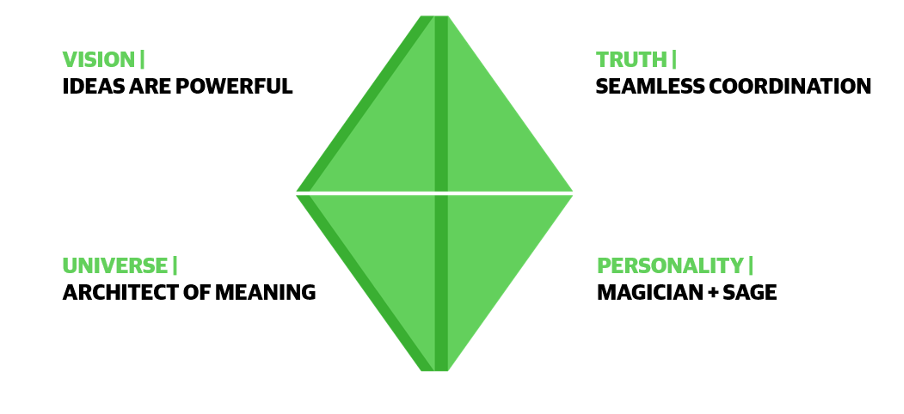
Labbrand’s 4 Facets model translates positioning into how the brand is actually experienced.
Truth defines the functional and emotional benefits the brand delivers.
Vision expresses the belief and future the brand stands for.
Universe creates the world the brand invites people into.
Personality shapes how the brand feels, behaves, and is recognised.
Together, these facets ensure that strategy moves beyond definition into expression — guiding design, communication, and experience in a consistent way.

A strong brand is not built through messaging alone.
Once the positioning and 4 Facets are defined, they inform how the brand is expressed across experience, communication, and architecture. These in turn shape how the brand is perceived over time.
This sequence matters. Skipping from positioning straight into campaigns often leads to inconsistency. A brand is built through what it says, how it behaves, and how clearly it is structured — not just how it looks.
In this sense, brand strategy should make “the” brand — not just its outputs.
For many organisations in Malaysia, the challenge is not starting from zero, but evolving what already exists.
This may involve refining a vision, aligning internal teams, repositioning for growth, or rethinking how the brand is experienced across markets and touchpoints.
In these situations, surface-level changes rarely hold. What is needed is a structured approach that can handle complexity and turn insight into clear, practical direction.
Strong brands are not built from instinct alone.
They are built from understanding — of the category, the customer, the culture, and the business — and from translating that understanding into a strategy that guides action.
That is how Labbrand Malaysia approaches branding.
Not as a layer added on top, but as a process that connects insight, strategy, and execution into one coherent whole.
If your brand needs greater clarity, alignment, or direction, an insight-led approach can help uncover what matters and define how to move forward.
At Labbrand Malaysia, we combine research, strategy, and brand building into one integrated process.




To improve your experience, we use cookies to provide social media features, offer you content that targets your particular interests, and analyse the performance of our advertising campaigns. By clicking on “Accept” you consent to all cookies. You also have the option to click “Reject” to limit the use of certain types of cookies. Please be aware that rejecting cookies may affect your website browsing experience and limit the use of some personalised features.