

In recent weeks, the #ALSIceBucketChallenge has taken social media by storm, spearheaded by former Boston College baseball player Peter Frate. This viral challenge aims to raise awareness and funds for ALS (Amyotrophic Lateral Sclerosis) research. Participants either take on the icy challenge or donate $100 to the ALS Association. Discover the impact of this philanthropic movement and its role in brand charity initiatives.
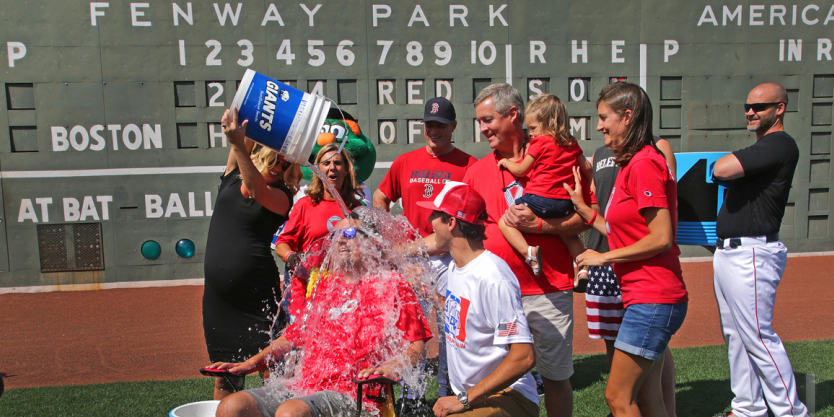
Though the campaign had a humble beginning, it soon attracted big names such as Bill Gates, Mark Zuckerberg, David Beckham, Robert John Downey Jr and even politicians including George W. Bush and Barak Obama (who chose to donate only).
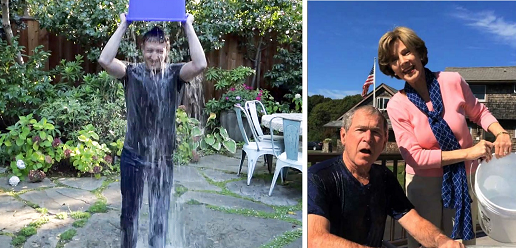
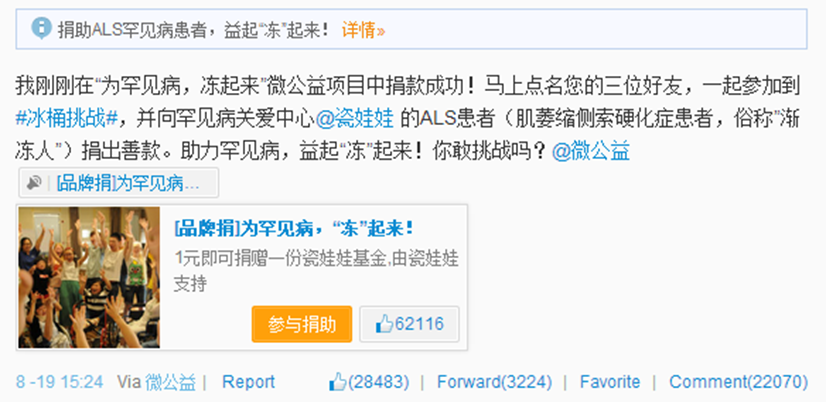
The #ALSIceBucketChallenge went viral globally, including in China, where celebrities and CEOs embraced the challenge to support the China-Dolls Foundation, a local rare disease charity. This philanthropic movement gained immense traction, with over $100 million raised for ALS research by August 29th, 2014, compared to $2.8 million in the same period the previous year. The impact extended to China’s Weibo, amassing over 4.5 billion click-throughs, with the hashtag #icebucketchallenge. Explore how this social media-driven brand charity phenomenon sparked widespread engagement and fundraising efforts. Weibo’s unique “hot topic” page features a link to a “Wei-Charity” (Weibo’s social charity feature) page for the China-Dolls Foundation, where netizens can make direct donations. By August 29th, this Wei-Charity raised over 7.3 million RMB.
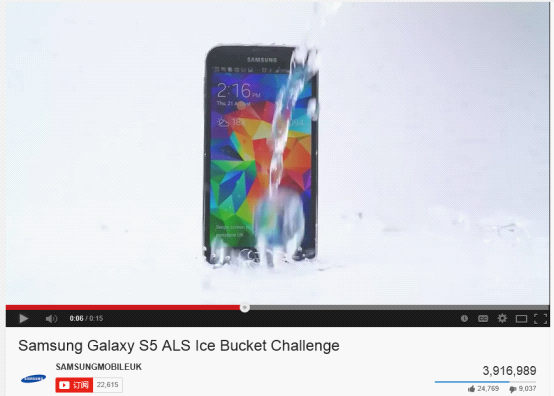
However, there are doubts that some brand participants tried too hard, diverting viewers’ attention from the charity itself to their brand messages, which seemed too tactful. Samsung even took it to the next level: One doesn’t have to be a real person to do the ice bucket challenge! Just recently, Samsung Mobile UK uploaded a video of its flagship product – Galaxy S5 being the protagonist of the challenge. In the video, the waterproof cell phone undertook the ice water with its screen on. It also deliberately challenged its counterpart gadgets – iPhone 5s, Nokia Lumia 930 and HTC M8, though failed to mention the cause of ALS. The video received nearly 30% dislikes, as many are unhappy that Samsung is seemingly taking advantage of a charity campaign to promote its product.
So how should brands respond to the Ice Bucket Challenge? Here are our recommendations.
Be straightforward and be personal:
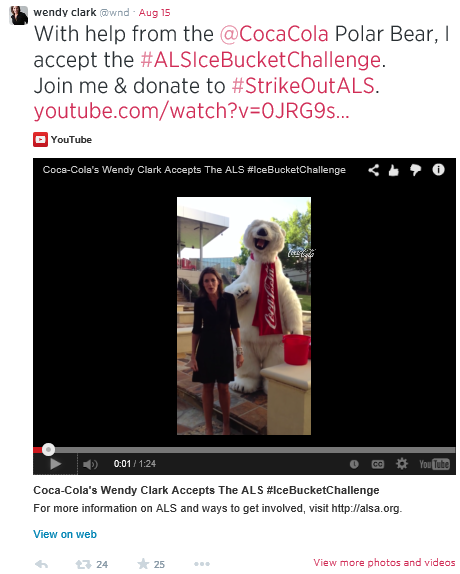
We consider Coca-Cola’s challenge an appropriate example. Wendy Clark, Senior Vice President of Integrated Marketing Communications and Capabilities at Coca-Cola undertook the challenge with Coke’s Polar Bear. The video posted via her personal Twitter account was “private” on Coca-Cola’s Youtube channel, which means only people who have seen her tweet can access it. She called on the audience to contribute to “wiping out ALS”, and nominated other brands with mascots such as Target and McDonald’s to participate and donate. Wendy barely mentioned Coca-Cola and kept the video straightforward and personal. What’s smart is that in the video, both the mascot and the branded towel that was used to wipe off the water were displayed naturally, making it a fun and practical addition.
In light of recent celebrity charity fraud scandals, public skepticism towards charitable motives has heightened. Brands are advised to adopt a simple and modest approach, avoiding excessive promotional content. Genuine participation and social responsibility already contribute significantly to reinforcing brand esteem. Wang Sicong’s Ice Bucket Challenge exemplifies this approach—he conveyed his message without words in a brief video and made a substantial donation of 1 million Yuan via Wei-Charity, providing a link for direct contributions to the donation page. Explore the impact of sincerity in brand charity initiatives amid growing public scrutiny.
Wang Sicong is the only son of realtor Wang Jianlin, CEO of Wanda Group. Wang Sicong sits on the board of Wanda Group and founded Prometheus Capital and Invictus Gaming.
Choose relevant causes to support
Given that a brand cannot support every charity, what kind of causes the brand chooses to stand by is an important reflection of its culture and value. If your brand would like to show support through events such as the #IceBucketChallenge, a simple (but visible) donation is sufficient. For long-term devotion however, we recommend that brands select one or two causes that are relevant to their businesses. This would show the public what your brand stands for. For instance, personal care brand Dove believes that true beauty lies in every woman, so founded The Dove Self-Esteem Project in 2004, a project dedicated to research and education, to help young girls feel confident about how they look. Dove also partners with experts and social organizations such as Boys & Girls Club, Girls Inc. and Girl Scouts.





To improve your experience, we use cookies to provide social media features, offer you content that targets your particular interests, and analyse the performance of our advertising campaigns. By clicking on “Accept” you consent to all cookies. You also have the option to click “Reject” to limit the use of certain types of cookies. Please be aware that rejecting cookies may affect your website browsing experience and limit the use of some personalised features.