

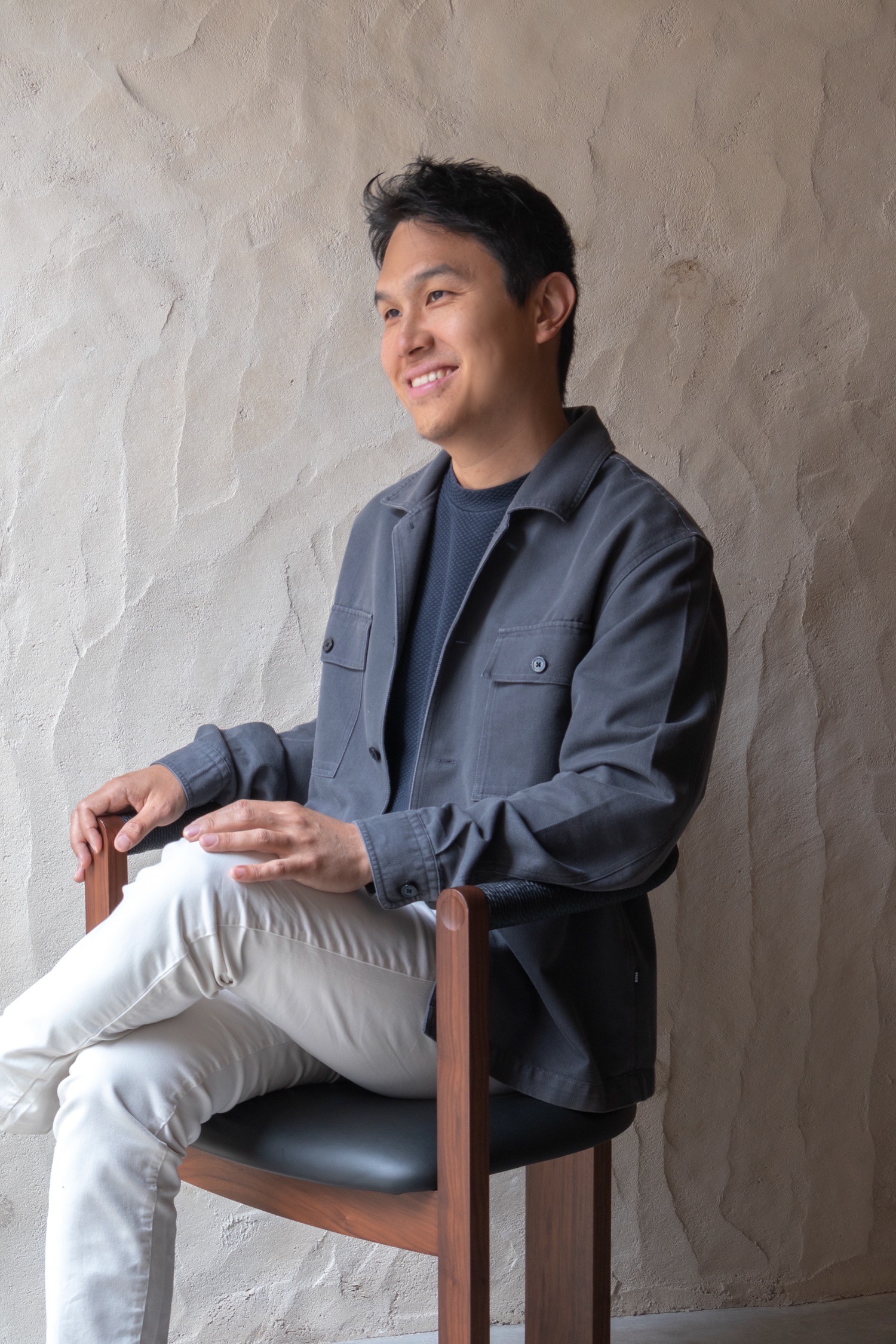
Born 1982 in Singapore, Gabriel Tan is a multidisciplinary designer who graduated from the National University of Singapore (NUS) Industrial Design in 2007. Since then, he has held several distinguished roles: he was a Partner at Outofstock Design from 2006 to 2015, founded Gabriel Tan Studio and Studio Antimatter in 2016, and has been a Creative Director of Ariake since 2016. A champion of craft processes, he co-founded Originmade in Porto in 2018, a brand that celebrates and revives the artisanal legacy of European makers. He is also the first Singaporean to work with the furniture world’s largest international names like B&B Italia and Herman Miller.
LABBRAND is delighted to speak with Gabriel about his perspectives as an all-rounded design expert, as well as his insights and experience within the realm of Hospitality Design:
1. Throwback to winning the coveted title of Designer of the Year at Singapore’s President’s Design Award 2025, congratulations! Since you are mostly based in Portugal, winning this award is a pinnacle of recognition especially on home ground. For all these years designing furniture, how does your approach to hospitality projects furniture differ to general furniture design, given the need to embody a brand story rather than an individual’s needs?
The award was particularly meaningful because Singapore is where my design journey began, so to receive that recognition here, while spending much of my time now in Portugal, felt like a nice full circle.
To me, hospitality furniture sits between product design, experience design and interior design. In hospitality, you are designing for different people from diverse cultural backgrounds, and furniture becomes part of a much larger experience. There is also a responsibility to understand the context of the place. The furniture shouldn’t simply be beautiful on its own; it has to belong to the environment, support the way people use the space, and communicate something about the hotel, restaurant or bar without becoming too literal.
For me, the interesting part is finding that balance — creating something with a strong personality, but allowing it to live comfortably within a much bigger story.
2. ‘Brand DNA’ is a term often used in hospitality. For you as a designer, what does that actually mean? How do you deconstruct the brand vision and brand concepts from the hospitality brands that you collaborate with to inspire forms, materials and textures for your creation?
I don’t really think of brand DNA as a checklist of colours, materials or references. For me, it’s more about understanding the emotions and human values that a brand wants to create.
I usually start by looking beyond visual language. How does the brand want a guest to feel when they arrive? What kind of pace does the experience have? Is it formal or relaxed, quiet or expressive, contemporary or nostalgic? Then I try to translate those qualities into physical things — proportion, weight, tactility, softness, texture and the way a piece interacts with the body. The ideal outcome is to let the user experience an intuitive connection to the brand, without a logo or obvious brand reference. If the proportions, materials and details are right, you can feel that it belongs without immediately knowing why.
That is much more interesting than simply designing something that looks “on brand”.
3. How would you describe your design philosophy? How do you balance creating a design that is distinctly ‘Gabriel Tan’ with one that remains authentically with a client’s brand?
I’m interested in the space between function and poetry. Furniture has to work well with the human body, but I don’t think functionality should be the only thing we see. There should be something that makes you want to touch it, sit in it, or simply spend time looking at it. I also don’t try to impose a Gabriel Tan aesthetic onto every project. I think having a design language doesn’t mean everything you design has to look the same. It’s more about the way you approach a problem — the attention to proportion, material, detail and how something feels when you interact with it.
When working with a brand, I see my role almost like a translator. I bring my own sensibility, but I’m translating their values into something physical. If I’ve done it well, you can recognise the character of the brand and still feel the designer behind it.
4. Let’s deep dive into the poolside furniture you designed for Raffles Hotel in Singapore. For a hotel with such long and grand heritage, did you feel a pressure to reference the history and expectation of the Raffles brand name or was the design approach aimed at a modern iteration of the current guest experience?
With Raffles, the heritage is so strong that I actually felt the furniture didn’t need to try too hard to reference it. There is always a temptation with an iconic brand to make historical references very explicit, but I think that can sometimes become too nostalgic. Raffles has evolved over generations, and its guests today experience the hotel very differently from guests a hundred years ago. So I was more interested in asking what Raffles means today, particularly in a poolside environment. It’s a more relaxed side of the hotel, so the furniture needed to feel elegant but also comfortable and effortless.
The challenge was to create something that could sit naturally within that very recognisable environment, respecting its heritage while still feeling contemporary. At the same time it had to fulfil many functional requirements of the Raffles Ops team, to be easy to clean, store bags of their guests and tray tables, and create more walking space. I think sometimes the best way to respect history is not to imitate it, but to continue the conversation.
5. While some of your past work in hospitality has been spatial and furniture design for hotel rooms and guest spaces, one of your most recent projects, BOP – Bartenders of Pony (in Singapore), moves into a completely different register: a bar. How does designing a bar differ from a hotel room, in terms of energy, functionality and how guests actually use it?
A bar runs on a completely different rhythm than a hotel room does. A guest room is private, quiet, used by one person or a couple over days. A bar is public, social, and loud in the best sense, so the furniture has to hold up to a room full of strangers arriving in waves over a single night, often standing, perching, leaning, not just sitting. With BOP, the furniture had to support that social choreography: how people gather around a bartender, how a solo guest perches for twenty minutes versus a group that ‘camps’ for three or more hours, how sightlines work toward the counter where the actual performance of the drink is happening. It’s furniture in service of a show so to speak, in a way a hotel room does not.
6. Function is critical in hospitality furniture. Can you give an example of how furniture at BOP prioritises seamless functionality for the guest yet sculpts the experience of the space? How did you want the guest to feel while interacting with it?
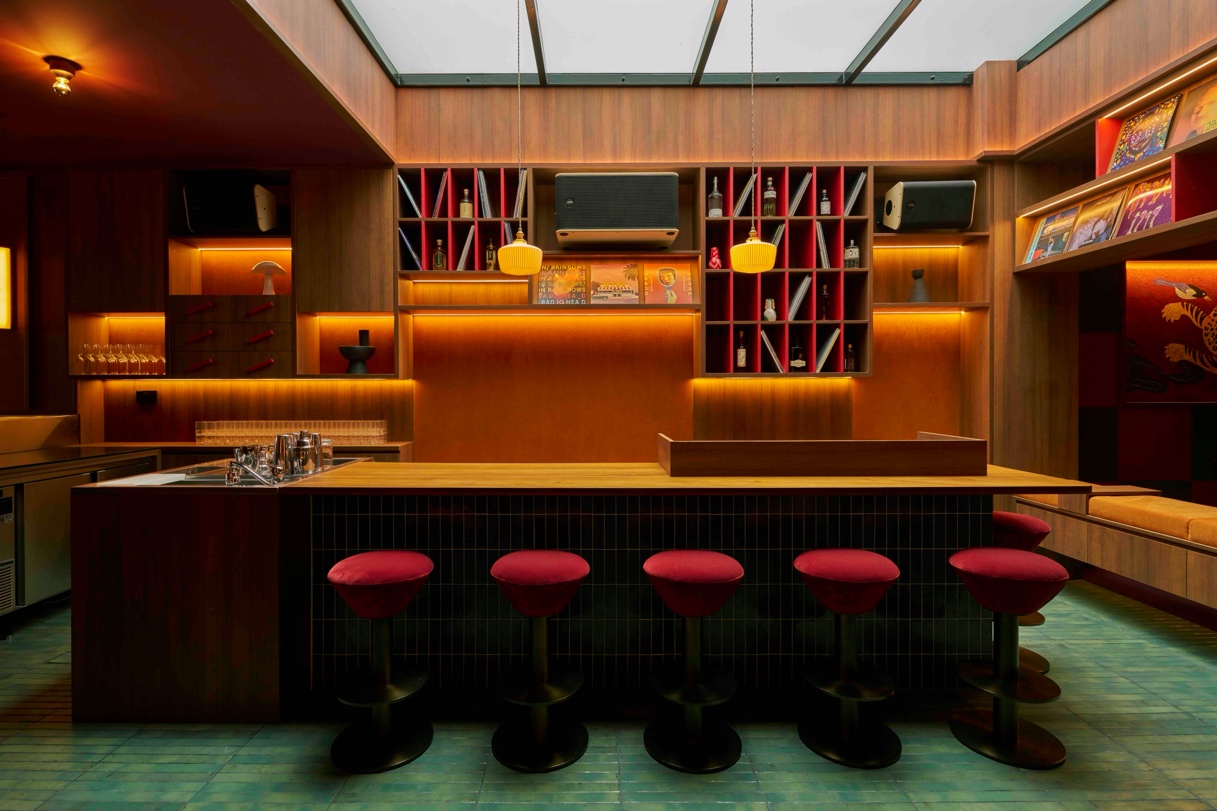
Good bar furniture behaves almost intuitively: a guest shouldn’t have to think about where or how to place a drink, a bag, an elbow or themselves. For BOP, we were designing for what is a good night out for different types of bar visitors: whether a solo drinker perching for a quick one, a couple settling in for a cosy evening, or a lively group of friends catching up over food and drinks.
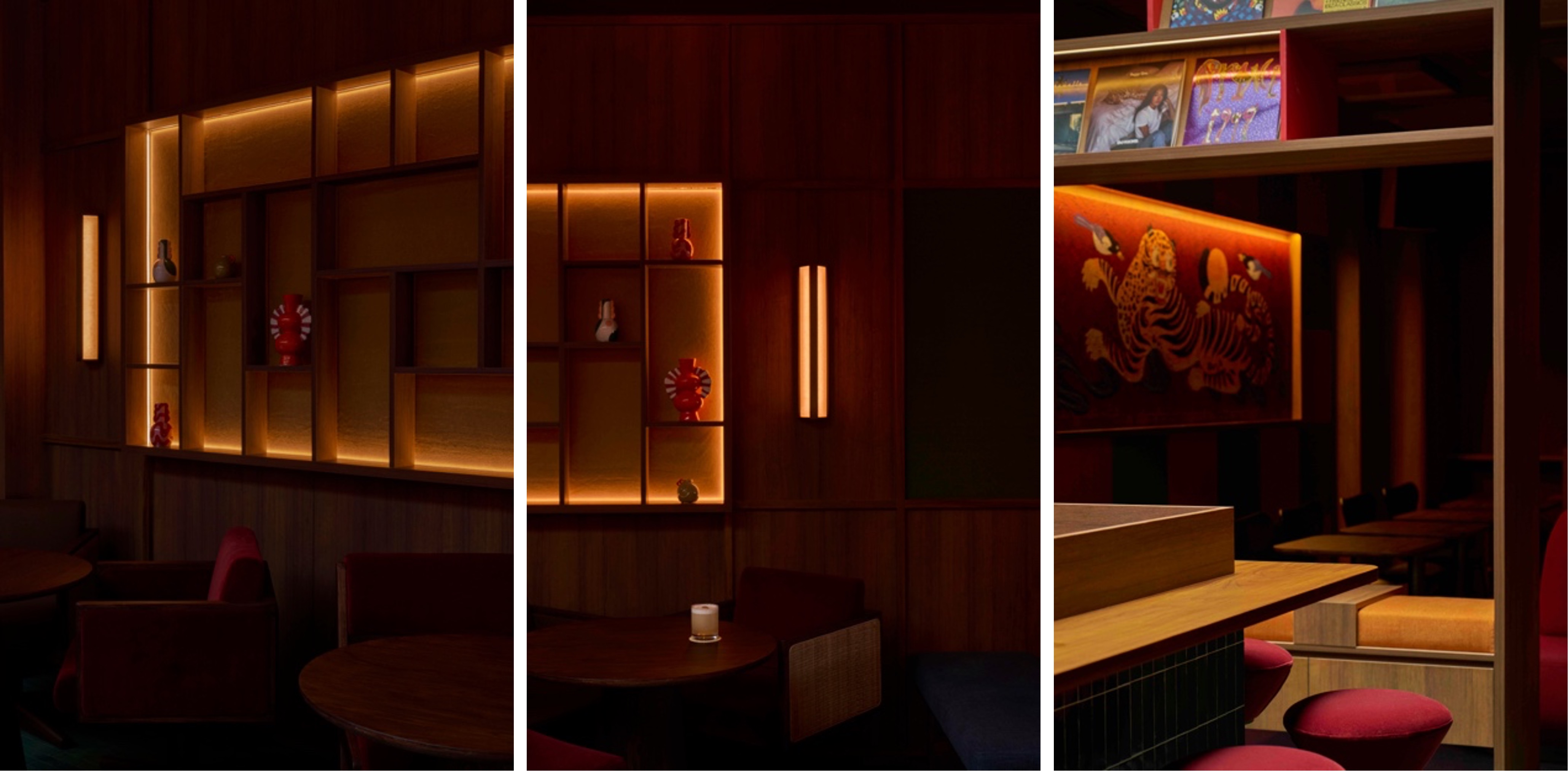
I wanted the functionality to disappear into the experience where the guest just uses the piece naturally, while the form gives the space its character and a sense of ease even when it’s busy. We designed an eclectic range of furniture for BOP including three types of low stools, two types of barstools, benches, sofas, two types of armchairs, as well as different wall, ceiling and pendant lamps. We wanted the space to feel like a home where the furniture is not cookie cut but mixed in forms, textures and colours. They also needed to dialogue well with the colourful acoustic textile walls, we were very pleased at how popular the bar is, and that the space feels comfortable acoustically even when it’s extremely full, which is an aspect of bar design that is often overlooked in my opinion.
7. Design for hospitality needs to be deeply collaborative. Can you please describe the challenges you faced – be it from hotel operations, hotel brand management and other departments – in realizing these projects, and how did you solve them?
Hospitality design is definitely a team sport. There are many different perspectives involved: the designer, architect, hotel operator, brand team, procurement, manufacturers, housekeeping and, ultimately, the guest. They don’t always have the same priorities, and that’s actually part of what makes the process interesting. A designer may be thinking about proportion and visual character, while operations may be thinking about cleaning, durability, replacement or maintenance. Both are valid. A beautiful piece that doesn’t survive hotel operations isn’t successful design.
I try not to see those constraints as obstacles. They often make the design better because they force you to understand the object more deeply. The process is really about finding common ground—knowing which aspects of the design are essential and where there is room to compromise. Collaboration doesn’t mean losing your design intent; it means finding a way for that intent to survive in the real world.
8. With Sustainability becoming an expected factor today, while balancing the consideration for design integrity, how did material sourcing and lifecycle (from production to maintenance) factor into your decisions for these high-traffic spaces?
I think sustainability in furniture has to go beyond simply choosing a sustainable material. For hospitality, longevity is perhaps one of the most important considerations. If a piece is well made, comfortable, repairable and able to age gracefully, that already has a significant impact on its lifecycle.
We try to look at where materials come from, how they are manufactured, how they will be maintained and what happens when a component eventually needs replacing. Upholstery is a good example: in a hotel, the ability to maintain or replace certain elements can extend the life of the whole piece rather than requiring the entire object to be discarded. I’m also wary of sustainability becoming an aesthetic. I don’t think something needs to visibly look “sustainable” to be responsible. Ideally, sustainability is embedded in the decisions behind the object, while the final piece simply feels like good design.
9. What are the trends that you see defining the next decade of hospitality design, and particularly into wellness in hospitality through furniture and finishings?
I think hospitality is becoming less about spectacle and more about how a space makes you feel. There has been so much emphasis on creating Instagrammable environments, but I think the next phase will be more sensory and experiential. People are becoming increasingly conscious of light, acoustics, tactility, air quality, temperature and materials, even if they don’t consciously identify all of those things. Furniture can play a big role in that. Softer forms, more tactile materials, better acoustics, furniture that encourages different postures and ways of resting — all of these can contribute to a sense of wellbeing.
I’m also interested in the idea of hospitality becoming less rigid. Instead of having furniture that dictates exactly how you should use a space, we can create objects that allow for different behaviours — working, resting, socialising, being alone. Ultimately, wellness shouldn’t feel like a treatment or a feature. It should simply be part of how a space makes you feel.
10. For a young designer aspiring to work on projects of this calibre, what advice would you give?
Stay curious and learn how things are actually made. It’s very easy today to be influenced by images and trends, but furniture is ultimately physical. Spend time in workshops. Understand materials. Make things. Visit factories. Talk to craftsmen and manufacturers. You learn things there that you simply cannot learn from a screen.
And don’t be too focused on having a recognisable style too early. Your voice develops through the work. The more problems you solve, the more you understand what you believe in as a designer. I would also say to be patient. Good projects often take much longer than you expect, and there are usually many more people involved than you realise. Learning how to collaborate, listen and defend an idea when necessary is just as important as having the idea in the first place.
11. And finally, if you could go back to change one thing in your process or design, what would it be and why?
I think I would probably spend even more time making and testing things physically at an earlier stage. When you’re designing, you can become very attached to an idea because it looks convincing on paper or on a screen. But the moment you make it at full scale, you discover something completely different—the weight, the proportions, the way your body interacts with it, the way light hits the material.
I’ve learned to trust those physical discoveries more and more. So if I could change one thing, it would be to prototype earlier and more often. Sometimes the smallest physical experiment can tell you more than weeks of looking at drawings. And occasionally it tells you that your beautiful idea wasn’t quite the right one—which is also a very useful thing to learn.
Thank you!
Stay tuned for future updates and insights from LABBRAND External Experts.
About LABBRAND | LABBRAND is a leading independent global brand consultancy founded in Shanghai in 2005 with offices in Paris, New York, Singapore, and Kuala Lumpur. Through seamless coordination of our expertise in Insights, Strategy, Naming and Design, we translate brand ideas into impactful identities and experiences that strengthen brand equity. Bringing strategy, creative experience and culture altogether into comprehensive brand systems to create and develop successful brands, we guide clients through every stage of the brand development journey. LABBRAND has been recognized by the world’s most influential award organizations, earning over 70 prestigious accolades including iF Design Award, Red Dot Design Award, London International Awards (LIA), Transform Awards in Asia, North America and Europe.




To improve your experience, we use cookies to provide social media features, offer you content that targets your particular interests, and analyse the performance of our advertising campaigns. By clicking on “Accept” you consent to all cookies. You also have the option to click “Reject” to limit the use of certain types of cookies. Please be aware that rejecting cookies may affect your website browsing experience and limit the use of some personalised features.