As long as there have been brands, there have been brand names.
Verbal Identities are oftentimes the very first touchpoint a consumer experiences. As a significant carrier of brand equity, an excellent brand name can be compared to an ingenious piece of artwork, drawing from culture, language, and creativity for inspiration. Yet there’s a bumpy journey to walk before the brand name eventually unveils itself to consumers. A great brand name comes from the comprehensive consideration of artistic elements together with more technical aspects, such as brand strategy and commercial and legal rules.
As the global leader in brand naming, Labbrand has developed a comprehensive naming methodology based on rich experience accumulated over the past decade. From these cases we have identified 5 dimensions that make up a strong brand name — general attributes (readability & memorability), brand strategy, business and trademark rules, adherence to linguistic check, and consumer insights. Labbrand has provided naming solutions to nearly 300 international and indigenous brands in coordination with our in-house market research and design teams. In this article we will touch on the three unique features of Labbrand’s naming methodology: proprietary naming software, legal risk screening, and our linguistic checking system.
Our Chinese naming software aims to enhance the efficiency and value of creation work. The software database records 6,000 Chinese characters, each character being marked with usage frequency and an in-depth analysis of sound and meaning. The ultimate goal is to intelligently generate brand name candidates that can follow multiple requests and criteria. For example: the software can understand criteria such as frequency of character usage, length of the name, and phonetic link with the alphabetic brand name; meanwhile, our goal is to allow it to understand from the creative brief the key brand attributes to be embodied within the name. We hope for our software to achieve this level of intelligence so that it can generate name combinations previously only achieved by Naming experts.
Currently, this software is able to make swift name combinations based on manually selected characters to broaden our creation scope, which can then be funneled down from hundreds of names to dozens of names and then to a final recommendation. During Quiksilver’s Chinese naming process, it helped generate more than 1,000 names during the creation phase.
Any brand who wants to have trademark ownership of its brand name in China needs to pass the trademark screening. Hence, Labbrand ties the name creation process closely with trademark risk screening to ensure solid protection of the brand asset. We assess the legal risk of Chinese names based on the same rules as the China Trademark Office (CTMO), and cooperate with a prestigious law firm to provide name candidates that stand firm from a legal point of view.
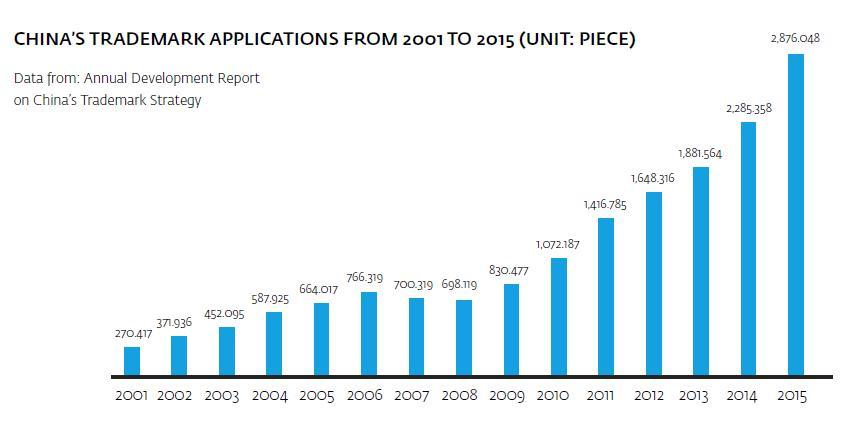
By the end of June 2016, the number of registered trademarks in mainland China has approached around 11,223,000 (published by SAIC on July 27, 2016), exceeding the combined amount of registered trademarks in both the EU and USA. Labbrand is fully aware of the difficulty and complexity of trademark screening and registration in mainland China. One important hidden risk is known as the “blind period”. The CTMO is not able to keep a real-time recording of newly applied trademarks given the enormous amount of applications. This creates a three-to-six-month blind period in which information is not accessible. Consequently, the trademark screening and registration risk is sharply increased.
To minimize such a risk, Labbrand consistently proposes that clients choose at least two name candidates to apply for trademark registration. In a recent case of product naming for Haribo, this method proved its value. Haribo registered two name candidates for one product brand. The top name encountered a similar trademark that received registration approval during the blind period while the backup name passed the examination successfully.
In addition to trademark registration screening in mainland China, Labbrand is also proficient in international trademark screening, covering the database of WIPO (international trademarks), CTM/OHIM (European trademarks) and USPTO (United States trademarks). Moreover, what makes Labbrand stand out is a powerful tool: integrating all three databases, this tool can instantly screen and show the risk level of a large quantity of names, with a list of similar trademarks for each name among all databases mentioned. This international trademark screening solution has significantly contributed to some successful naming projects, showcased by KADJAR, the new cross-over model officially launched by Renault in 2015, and PHIDEON, the brand-new Volkswagen C-class luxury model.
Considering the increasingly globalized market and wide array of languages around the world, Labbrand includes linguistic check in our methodology to detect any potential negative associations of name candidates in different languages or dialects. To do so, Labbrand developed a specialized online linguistic check tool at www.thebrandchecker.com. Linguistic checkers are strictly selected and native speakers of the tested language or dialect. A standard linguistic check provides feedback on multiple aspects, such as pronunciation & sound, basic connotation, industry association, and more.
A Chinese brand naming project needs to be applicable to many markets within China where many different dialects are spoken. As such the standard dialect check includes Mandarin, Cantonese, Shanghainese, Minnan dialect, and Sichuan dialect. In the Chinese naming project for booking.com, one name candidate 乐栖 [ lè qī ] was found similar to 落仔 [ luò zaǐ ] (abortion) in Cantonese; another name 悦订 [ yuè dìng ] sounded similar to 毓婷 [ yù tíng ] (contraceptive pill brand) in Shanghainese.
For an alphabetic name that targets the global market, all main languages around the world must be considered. There are around 20 common international languages that we check, including English, French, German, Spanish, and Japanese. Sometimes this can prove very useful. For example, in the naming case of Lamando, the brand-new A-Class four-door car model launched by Volkswagen, one name candidate CAVADO was detected to carry seductive meanings in Spanish, while another name AGGEDIA reminds checkers of tragedy in at least four languages.
Aiming to minimize the potential threat of bad performance in naming candidates, linguistic check is a crucial step in brand naming that requires a local understanding of languages and cultures.
Labbrand’s Chinese naming software, trademark registration risk screening and linguistic checking tool are inextricable but irreplaceable parts of the Labbrand naming methodology, laying a solid foundation for successful naming. But while these tools are helpful, they derive value from a comprehensive approach to brand naming: one that focuses on nuances in language, employs knowledge of local culture, and recognizes the power a brand name can imply. Together with the ingenious inspiration of our professional name creators, these elements make up the indispensable conditions for a strong brand name.




To improve your experience, we use cookies to provide social media features, offer you content that targets your particular interests, and analyse the performance of our advertising campaigns. By clicking on “Accept” you consent to all cookies. You also have the option to click “Reject” to limit the use of certain types of cookies. Please be aware that rejecting cookies may affect your website browsing experience and limit the use of some personalised features.